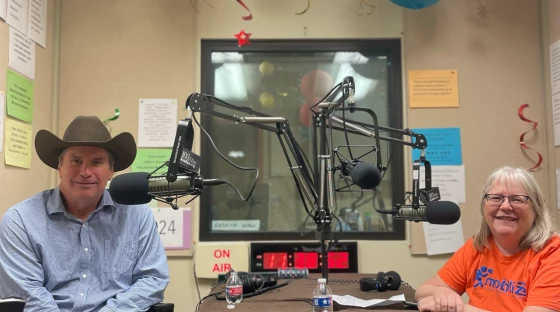
April 19, 2024: Parking Mobility project director Mack Marsh introduces Waco to a new way to address accessible parking violations that we’re working to bring to Waco. Listen here.
The following transcript of the interview was produced by Mobilize Waco transcriptionist Amanda Cox.
Living It – Mack Marsh
The best way to understand disability is to learn from people living it. This program features conversations with our disabled neighbors about the challenges and joys of navigating life in our community. Our host is Meg Wallace, director and organizer of Mobilize Waco, a disability justice coalition working toward full participation and leadership by people with disabilities in the Waco area. On this episode, Meg welcomes Mack Marsh. Mack oversees all operational and strategic responsibilities of Parking Mobility, a nonprofit community education and enforcement program designed to efficiently address accessible parking abuse.
Meg Wallace: Mack, thanks for coming up to Waco. How far did you travel?
Mack Marsh: Meg, it was a beautiful drive up through the Brazos Valley. I came from just north of College Station and drove up to Waco.
Meg: Well, so give us some background on you. What brought you into the accessibility arena?
Mack: So, 23 years ago, I experienced a traumatic spinal cord injury. I dove in the wrong end of a swimming pool and broke my neck. Spent 28 days in a coma and 4 1/2 months learning how to do things like sit up in bed and tie my shoes. I wear boots now so I don’t have to worry about that. But I was very quickly introduced to the disability world. And one of the very first issues that I experienced was accessible parking abuse. I took my son to a baseball game, came out of the baseball game, and someone had blocked my van in that striped area, had kept me from being able to get into the vehicle because I couldn’t deploy the ramp. And so, in the hot summer sun, I overheated really quickly and ended up having to go to the hospital. The violator never knew it happened because we were gone by the time they got out of their baseball game. And so, I know that it didn’t change their behavior.
Meg: You were gone because you were you taken by ambulance to the hospital?
Mack: Taken by ambulance to the hospital. That was my son’s very first ambulance ride, was to take dad to the hospital because he had overheated in the hot Texas sun. And so, it’s really important that we protect these spaces. And so, that started a journey of investigating trying to learn more about this issue. I’ve done a lot of other jobs between then and now, but for the last 12 years or so, this has been my primary mission, is to solve accessible parking abuse. And in doing it in a way that builds relationships, engages people, and educates people to change their behavior.
Meg: Well, so I was looking at your website for Parking Mobility, and we are hoping, by the way, to bring this program to Waco, which is why we kind of broke our—we kind of are committed to interviewing disabled Wacoans and occasionally their caregivers, but we broke our rule for you. Because we really want folks in Waco to hear the story of Parking Mobility and what it is you’re working on. But I was looking at your website, and I saw that you’ve worked for a number of independent living centers around the state, and you also had a key role in recovery efforts after Katrina.
Mack: Yep. So I was actually the center director for a center over in Louisiana when Katrina hit, and so we were the only center in the state that wasn’t directly impacted by the storm. So we were the only ones left in operation. And so that was our focus for about eighteen months after the storm—was really serving those that had to flee the Gulf Coast, helping them to get the equipment that they needed, get the services that they needed, get relocated, and in many instances, really helping people save their lives. We saw a lot of issues in some of the shelters at that time.
Meg: I bet when we had the winter storm a while ago, you were having some flashback to that time.
Mack: Right, well actually another big passion of mine is emergency preparedness and communication. Our organization is also working on some products in that direction. Even though we’re not quite ready to come to market yet, we’re excited about the potential of that. I lost six very good friends in Hurricane Katrina in the aftermath. And so that’s a real passion of mine. A personal passion of mine is to develop an effort that will save lives.
Meg: Yeah. So, I think what’s interesting about this is not only are there everyday things like, I have to wait until someone moves their van so I can take off and hopefully I’m waiting in an air-conditioned space. There are a lot of things when you’re not ambulating on your feet that really can be a life-or-death situation and anywhere in between. So being concerned about parking mobility, people being able to park, get into a spot, get out of a spot, get into a business and out again, is not just something we can get to when we get around to it.
Mack: Right. Well, and it’s something that most people don’t recognize impacts the entire community. When people with disabilities are unable to park, they’re unable to access all the goods and services the rest of us can. And what that does is that impacts our economy. That keeps businesses from being able to benefit from good customers. A lot of times, and I’ve had many people tell me over the years, that because they can’t park, they don’t go out. They don’t go into the community. They don’t spend their time, their energies, their passions, and their money in our community. And so accessible parking is more than just a convenience. It really is the first point of failure to an accessible community.
Meg: You know, we were traveling from Waco to Gainesville, Florida, and kind of going off the beaten path, not just doing the interstates. And I have felt like, Waco, you just don’t see a lot of people in wheelchairs, and people with, you know, canes, white canes, or guide dogs out in the community. And is this just a Waco thing, or is this a southern thing, because I came from Chicago. And we went across the south, not on the interstate. And I saw people out in the community almost every time we drove through, using wheelchairs and so on. I think Waco really is behind.
Mack: I don’t know. I’ve not spent a ton of time in Waco. I do come through occasionally. I travel all over Texas. I don’t think that there’s a big difference in what I see here in Waco as to other communities. I think there is maybe a segregation of the disability community from the overall community, but I think that happens in a lot of communities across the country. Obviously in our big cities, there are better services. Chicago is one of the most accessible cities in the world. And I love it. You know, they have great public transportation. They’ve got a vibrant, active disability community. But it’s because they have those services. They have those resources. When we do that, you guys with Mobilize Waco are a great example of that. When you create an accessible community, people tend to get into the community. You’ll see more people because it is an accessible community and they’re no longer afraid to go out.
Meg: Right, right. When I first, I moved here in 2016, I was going for a walk with accessibility on my mind and I walked to the courthouse and I realized that, it was 2018, and from at least that side of the courthouse you could go down a ramp on one side from the courthouse but you couldn’t go up on the other side. How do you get to 2018 and someone who has business at the courthouse can’t go down the street for a cup of coffee?
Mack: I see those curb cuts to nowhere all the time.
Meg: Exactly.
Mack: We do a really good job of thinking through sometimes new builds. So, I know you guys are working a lot with TxDOT and putting in making sure that those curb cuts and crosswalks are there. And a lot of times we do that really well when we’re pouring new concrete. But we don’t think about where that goes, where that leads. So, does that sidewalk continue down the other side of the road?
Meg: Exactly.
Mack: And where does it go? And those are the types of things that as more people are out in the community, as they are given the opportunity to have their voices heard and to be a part of that change, can be really exciting aspect.
Meg: That’s why one of our key principles is visibility.
Mack: Right.
Meg: We want to be out there where people can see us with our bright orange t-shirts and really be thinking about these things. I noticed on your—and we’re going to talk about Parking Mobility specifically—but I kind of want to paint a broader picture. On your website, it says, there’s two things that it says that I’d like you to address. One is, “It’s about accessibility, not disability.” Tell me about that statement.
Mack: So we don’t focus on people’s disabilities. There are lots of different disabilities. There are as many disabilities as there are people. And so we really want to focus on accessibility. We want to focus on making sure that there’s an attitude of accessibility. Changing people’s behavior through education does that. When a business recognizes that accessible parking is an important part of their business, they start to think about other aspects of their business. How wide are our aisles? Are we making sure that we’re keeping our restrooms clean and clear and able for people to use? Are we making sure that our doctor’s offices are fully accessible? Are we thinking about more than just parking? Are we looking at exam tables? And so, when we talk about accessibility, we’re talking about that broader picture. I love talking about Parking Mobility because it’s a great example of how we can advocate effectively, but it’s not just about parking. It really is about being in an entire attitude of accessibility.
Meg: That pretty much explains the second thing I wanted to ask you about from your website. So Parking Mobility is a program to improve enforcement of accessible parking, but yeah. And as I’m saying that, you’re kind of saying, you got that, “yeah, but not exactly” look on your face, right? And so on the website, it says, “Enforcement is essential, but education changes the behavior.”
Mack: Correct.
Meg: So go ahead and tell us about Parking Mobility, the organization, the app, and with that in mind.
Mack: So one of the things that we recognized when we got started was that the state laws allowed for enforcement. So people with disabilities, actually anybody, can issue a citation in the state of Texas as long as you’re approved by your local community. So typically a law enforcement agency that says we’re going to have a volunteer program. There’s training involved, so people have to be trained. They have to be vetted, so they need to have a background check, make sure that they’re doing these things for the right reason. But that enforcement doesn’t change behavior. One of the things that we found early on was that when we increased people’s enforcement, so we got more tickets out there and people were paying those fines, but we’re still seeing recidivism. There was a 60% recidivism rate. People who got a ticket paid the fine and they repeat offended.
Meg: Okay, so how much was this fine?
Mack: $500.
Meg: $500?
Mack: Texas has the highest fine in the country. $500 minimum fine for a first offense.
Meg: Wow. Minimum?
Mack: Right. It goes up from there. It can go up as high as $1,500. We don’t see typically judges imposing that. In fact, we don’t see judges imposing the $500 fine very much. One of the things that we found was that there was an 80% dismissal rate. So judges were dismissing eight out of 10 tickets, even tickets that were issued by law enforcement officers. And there’s a lot of reasons behind that. We talked with judges and we said, “Hey, why are you dismissing these tickets? This is a really important issue for us with disabilities.” And they said, “Well, we really don’t like to be punitive.” And when you have a ticket that’s $500 for a minimum, first offense, and there’s a same infraction, someone parked in a double-parking situation or someone in a fire lane where the fine is only $25, that’s punitive. There’s a misconnect there. So it’s actually us, the advocates, who had fought for that $500 fine that were the problem. We asked for that fine, not understanding the consequences of that fine.
Meg: So yeah, so if the fine is too large, it’s hard to get the system to actually impose it.
Mack: Right.
Meg: I’m trying to picture this though. If I get a ticket, I just pay it. I don’t get a judge involved.
Mack: Almost nobody pays a $500 fine. They’re going to show up and say, “Is there something I can do?”
Meg: Okay, so this is the sort of ticket, if you get it, you are going to go and fight it. As opposed to other ones where—
Mack: Right, because it’s so large.
Meg: —Oh, I’m going to have to pay this. Because it’s so large.
Mack: And so many people show up and say, you know, I did it, but I really can’t afford to pay the $500. Well, the judge doesn’t have an option. It’s a minimum fine. And so what they’re doing is, you know, a single mom comes in and says, “Your honor, I did park in that spot, but it was pouring down rain. My child was sick, and I ran into Walgreens to pick up that prescription.” And the judge says, “You know, that’s too much. It’s just, it’s not worth it.” So they dismiss that fine. What happens over time is that becomes an unenforced law. And what is an unenforced law?
Meg: It isn’t a law.
Mack: It is an unenforceable law. And that’s what’s become of this law. So a lot of law enforcement officers learned, “I’m not going to do this paperwork. I’m not going to write this ticket because it’s going to get dismissed.” And so they stopped writing tickets. And so then there became no enforcement. Once there’s no enforcement, people learn, I can park there. There’s no ramifications for it. I’ve never gotten a ticket and I’ve done it a hundred times. So I’m just going to keep parking there.
Meg: Okay. I was thinking that people had paid the 500 and that didn’t deter them next time. It’s that they were never paying.
Mack: Right. And so that was the big problem. That was the first problem that we looked at. So we asked those judges. So how do we solve this problem? And they said, give us an alternative. Our job as judges is not to punish people. It’s to change behavior. So help us. So we developed our education, our Offender Education Program.
Meg: I want to hear about that, but I want to back up just a minute.
Mack: Sure.
Meg: Because you’ve been talking about we. Who is we, and how did we become a we and not just several Is frustrated in different communities?
Mack: So it’s funny that this entire effort started at a beer summit. There was five of us that were sitting around one Friday evening having a beer and solving the world’s problems. Here’s all the things that are going on. And, “if we could only, if we only did this.” And so it was five of us that got started and we were all people with disabilities who worked in some capacity as advocates. Many of us, at the time I was working in employment advocacy, so I was doing a lot to create employment opportunities for people with disabilities. And so, we were talking about it, and I’m a numbers guy, and I said, “Well, first thing we have to do is we have to prove there’s a problem.” We know it’s a problem, we see it because we’re affected by it. But there’s no numbers. There’s no proof that we can take to elected officials and say, hey, there’s a problem. We need to find a solution for it. And so one of our guys who did a lot of tech advocacy, he’s worked in the Austin area for a long time. He’s a tech geek that does a lot to develop technology that’s accessible. He said, why don’t we build an app? And so we did.
Meg: Awesome.
Mack: We did Parking Mobility and that’s really, at its core, what the app does: is just collect data. And that helps us to prove that there’s a problem, but then it also helps to advise the solution. And so, when we have, when we have proof that something’s a problem, we can also prove what works. And when we started educating people, when we started that Offender Education Program, we went from a 60% recidivism rate, those people that were paying those tickets and repeat offending.
Meg: Or going and asking to be—having it dismissed.
Mack: Or having it dismissed. And those dismissals were even higher. They had a 90% recidivism rate in those. When we started educating, instead of just dismissing or just fining, we went to zero percent recidivism rate. We’ve had over 25,000 people that have completed our Offender Education Program. And we’ve only had seven people that have repeated offended. That is a 0% in my book.
Meg: Yeah, wow. That’s phenomenal.
Mack: And what that does, is that proves that we can change people’s behavior by explaining why those spaces are important, really making it personal. We’re kind of proud of that program because we also use it as a recruiting tool. A lot of our volunteers are people that got a ticket, took the class, and then came back and said, “You know, I really want to be a part of this solution. I want to be a part of making our community better.” One of the things that we found, and where the numbers really surprised me, was that 63 percent of people who offend are people with disabilities. They’re people that forgot to put up their placard, or they park in those blocking violations, or for some other reason aren’t following the rules. A lot of times they don’t even know what those rules are, and that offender education helps to educate people, helps to change their behavior by helping them know what the rules are. When we educate ourselves, when we as advocates look inward and say, “what can we do, what are we doing to exacerbate this problem, what are we doing to make it worse,” and instead, “what can we do to be better,” then we start to identify where we’re kind of causing the problems ourselves. And so as advocates, it’s really important to start there.
Meg: Yeah, that makes lots of sense.
Mack: What can we do better? What can we do better in order to make our community better?
Meg: So we could just start this in Waco like, tomorrow, right?
Mack: You can actually. Actually you’ve already started this in Waco. So using the Parking Mobility app, and this is kind of counterintuitive, a lot of people think, well, I can use that app as soon as we start issuing tickets. The reality is, we’re never going to be able to issue tickets in Waco until you use the app. So we need those numbers. We need you to be able to help us prove that there’s a problem here in Waco. Use the Parking Mobility app. We get those numbers. And then we give it back to you. It’s your data. You collected it. So we’re going to work with Mobilize Waco. We’re going to work with anybody who uses the app. We’re going to provide you with information, information that you can use to talk to your elected officials about the problem. That data that shows that there’s a problem, shows where the problem is, when the problem is, how the problem is, and then here’s the solution. Here’s a way that, one, is economically feasible for the community. This program has always been cost-positive, so it generates more revenue than it costs for the community. And it’s also a way of reducing that confrontation that occurs. So a lot of times people get angry when they see a violation. Instead of getting angry and confronting someone, now you have a proactive way of addressing the issue that’s nonconfrontational.
Meg: So, tell me the Hays County story. Knowing that we had a little back and forth about this, that this isn’t necessarily the way it always goes, but it’s a great story.
Mack: So, I think you’re talking about actually Travis County.
Meg: Oh, I thought it was Hays County.
Mack: So, this is where at the very beginning, we went to some elected officials. We had some relationships from other things that we had done with elected officials. And we said, you know, this is a problem in our community. This is when we were brand new, we had no data. And we talked to this one elected official, this one county commissioner, who said, “I don’t believe anybody parks in those spaces illegally. I see those spaces empty all the time. Prove to me that it’s a problem.” So we did a challenge. We took 10 people and we said, for the next 10 days, go out and actively look for violations. We actually set quotas, which we don’t do, because it doesn’t work. And it kind of gives us a point in time issue, instead of saying it’s a larger issue.
Meg: So you wouldn’t necessarily recommend doing it this way, but it’s a great story ’cause in those 10 days, how many violations did you uncover?
Mack: Over 1,000.
Meg: Wow.
Mack: So we actually printed a—893 that we printed as tickets. So we took the three photographs.
Meg: They weren’t actual tickets. They were kind of like, this is what it would be like.
Mack: We printed it in the ticket format that it would be. And so, and we had it nicely bound, put into a book, put it on his desk. And to my knowledge, he hasn’t even opened it. But he still is one of our biggest champions to this day. He said, “You’ve proven to me that it’s a problem.” And he said, “You know, honestly, after our first conversation, I went out and looked” and he said—
Meg: Once he was paying attention, right. So they bring it in to Travis County. And what is it exactly that’s brought in there? And that could be brought in here? If we got it done, if we did our data collection, and got it done.
Mack: So what we do, what we provide for our communities, our partner communities, is a volunteer enforcement and education program. So Texas law, Texas Transportation Code 681, allows for citizen volunteers to issue a citation to someone who’s parked illegally in an accessible space. And so, using the app, our volunteers, once they’ve been trained, there is a training requirement, they still use the app just like you can use the app today, but we elevate their account. So they’ve been through the training, they’ve been approved. Their local law enforcement has said, you can issue a citation. They use the app. That report then goes to law enforcement. They review that report, they see the photographs, they see the violation. The law enforcement officer clicks a button and a ticket gets mailed to the owner of the vehicle. That person then has three options. They can pay the fine, $500 plus costs is $561.83. Or they can request a court date if they feel they’re not guilty. Less than 1% of our cases ever go to court because it’s kind of hard to say I’m not guilty when there’s three photographs of your violation or because of that offender education. So we give them the option of paying a reduced fee. The court sets that fee. It’s typically half of what the ticket would be, and they have to complete that class. It’s online. It teaches them about what the rules are, why those spaces are important, how they can keep from violating again, and the importance of the disability community to the overall community. And that’s really what engages people, changes their behavior.
Meg: So, but the course is half of the ticket cost, so the course is $250.
Mack: Correct. So it’s still a pretty high fee. Some courts charge a little bit more. Some charge a little bit less. That money doesn’t go to Parking Mobility. That goes to the court. And it’s the court’s decision as to whether or not—or how much—to charge. But there’s a concept called perceived value. If we gave the class away free, people wouldn’t change their behavior because they wouldn’t perceive it as being important. When they have to pay for it, then they understand that there’s a value to it.
Meg: Sure, sure. So you have an education thing that you show people, and I understand you can make that Waco oriented.
Mack: Yes, so every single partner community, it is customized. You know, it’s kind of hard to show somebody in Chicago, a training video that was shot in Waco, and have them go, “Oh, that’s here.” It looks different, right? And so every community has to look different. Every community has to have ownership. Every community has to understand this is us. And so that’s why it’s really important that we do that, and we do that in every one of our partner communities.
Meg: That’s great. I want you to address one other thing. We’re getting close to the end. But one of the station managers here has been using the app to report violations, but she was concerned because, you know, it feels vulnerable to be out there taking pictures of somebody. And you’re not issuing a citation and putting it on the windshield, you’re just making a report in an app and it goes to the police station if—Okay, but you explained to her how it can be done so that she doesn’t feel so vulnerable. Do you want to say a little bit about that?
Mack: Sure, so the first thing is, if you don’t feel safe reporting, don’t report. If you feel like there’s going to be a confrontation, don’t report. If you’re reporting and someone comes up to you and says, “What are you doing? Why are you taking a picture of my car?” Don’t say. “I’m issuing you a ticket.” Say, “I’m collecting data.” Because that’s really all you’re doing. And most of the time people will, as long as you don’t make it about that car, people are going to leave you alone. But also, it’s important to be discreet and fast. The Parking Mobility app takes less than 43 seconds on average to report a violation. If you take the three photographs in the app, and you must take the pictures in the app, there’s a reason for that. I know we won’t have time to get into it. But take those three photographs in the app, move away from the vehicle and complete the report. That way you’re not putting yourself into a confrontation situation. Confrontation is never good, doesn’t change behavior, doesn’t change people’s attitude, actually only makes it worse.
Meg: But to go ahead and get these pictures and submit it and have someone go through education, that does make change.
Mack: That does change behavior, because then they can get mad in their living room when they get that ticket in the mail.
Meg: But then they’ll get educated and they can see why.
Mack: Then they’ll have the education option, they calm down, and they understand exactly why.
Meg: So at the time of this taping, we don’t yet have the Parking Mobility program adopted in the city of Waco or in the surrounding communities, but we are beginning to collect data. So if someone wants to get on board, what can they do right now as they’re listening?
Mack: Download and use the app. Go to your app store, either Google Play or the Apple App Store. Download Parking Mobility. Register an account, and start using it. Play around with it. Try to break it. I tell people all the time, you cannot break this app. If you break it, that means we didn’t do it right. Do test reports. Those test reports help you understand how the app works when you do see a violation. And then just start using it. One of the great benefits is, you’ll immediately start seeing spots that appear on the map. So now you can find accessible parking using the Parking Mobility app. That’s a great benefit.
Meg: And you can also use the app to collect data about places where there is not marked accessible parking but should be.
Mack: Exactly. You can do suggesting spots. You can report spaces that aren’t fully marked properly. That helps us educate business owners as well.
Meg: This sounds great, like a great opportunity for Waco and our surrounding communities. Thank you so much for coming and telling us about it.
Mack: Thank you so much, and I really look forward to working with you guys here in Waco. Reach out to me at ma**@*************ty.com and I’m happy to answer any questions anyone has.
Meg: All right, have a great day.
Mack: You too.
Meg: Thank you for living it with Mobilize Waco. I’m Meg Wallace. For resources on today’s topic, visit mobilizewaco.org. Living It is a production of KWBU. You can hear this program every third Friday of the month, and at KWBU.org.
 New ideas
 Improvements
 Community needs
 Conversations that matter