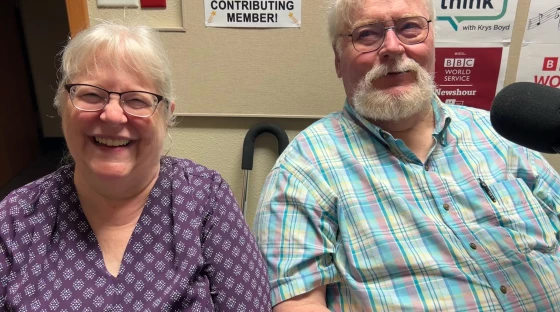
Meg Wallace and EG White-Swift discuss the events that led to EG becoming legally blind, adaptation to life after vision loss, and a number of resources that are available and advantageous to those with visual impairments.
Meg Wallace: Morning EG, thanks for coming on the show.
EG White: You bet, I’m glad to be here.
Meg: So I know you from the Likely Stories book club, KWBU’s book club, and in that club we read books that have been reviewed right here on the station. So I got to know you over there. And I learned that you are using audiobooks for the book club because you have significant vision loss. So tell us a little bit about that.
EG: Well, I’m legally blind. But that doesn’t keep me from doing things like reading because there’s a lot of resources out there for that. But my vision loss started about twelve years ago when I had my first cataract surgery. And then since then I’ve had about three retina surgeries in each eye. So about ten years ago I actually became legally blind and could no longer drive. So when that happens, what really kind of happens when you get your initial diagnosis is your ophthalmologist says, “Well, Mr. White-Swift, your eyesight is starting to fail. And can you come back and see me in six months?” and you walk out of the office and go, “What the hell do I do now?
Meg: Wow, so you’re scaring me a little bit because you said this whole thing started with cataract surgery. So you had pretty much normal vision. Maybe wore glasses. So did that have to do with your cataract surgery or how did that happen?
EG: Well the ophthalmologist will tell you that once you have cataract surgery, you do have a chance of having retina detachment. It increases the odds of that.
Meg: Wow.
EG: Now, in my particular case, it’s really more genetic. My eyeball is bigger than my retina. But so any time you have any kind of operation on your eye, it can lead to additional problems later. But there’s a lot of different causes for people to lose their eyesight. Some of it’s industrial accidents, some of it’s genetic. There’s a lot of different types of vision loss.
Meg: So you, growing up before your cataract surgery, were you aware that you had that disproportionate size in your eye?
EG: No, I was severely nearsighted, but I didn’t really know until I had the cataract surgery.
Meg: Wow, so I’ll tell you why that made me say, “Oh my gosh, that’s scary,” is my husband just had cataract surgery and he’s fine, but I’m starting to develop cataracts, and I’m severely nearsighted. I need to ask my doctor about that.
EG: Typically what happens is six to eighteen months after you have cataract surgery, if you start to get a lot of floaters, large floaters in your eye, then that means you need to go see an ophthalmologist that day. Now I waited probably just a little bit too long. I actually had what they call the shade starting to come down over my eye.
Meg: Wow. And then they discovered that you had a retinal detachment going on?
EG: Yeah.
Meg: Okay. I actually recently started to get a lot of floaters. I haven’t had cataract surgery yet. And it was just really bothering me. And I’m like, but it’s not an emergency. Uh, Let me go in. And I was really surprised. I thought I’d have to wait two, three months for an appointment. They got me in that day. Or, the next day. And I told him I was really surprised about that. He said, “Oh no, we treat this as an emergency. It turns out you’re fine. But that’s exactly what you should do if you suddenly see—” And what are floaters like?
EG: Well, you normally have floaters all your life. The little small ones look like if you took a pen and put a little dot of ink on your eye and it floated around. But these floaters are big. They’re suddenly like they’re the size of turtles. I mean, they’re going across the eye and they’re big. But they’re blood is what it is. When your retina starts to detach, it allows blood to flow across your eye.
Meg: But if your retina is not detaching, it can just be, I think it’s like vitreous fluid or something like that.
EG: That’s correct.
Meg: It does kind of float across your vision. I notice that I really see them if I’m driving or looking at the sky. That’s when I really notice them. So they’re not, I’m not trying to be a doctor here, but this happens to a lot of people.
EG: Correct.
Meg: And so they’re not unusual, but if you see a sudden increase in them or a flash of light, I think is the thing that you really should—
EG: —A flash of light. But an increase in size is probably the most important thing. Where you would see multiple large floaters at one time. So that’s a call to the ophthalmologist right now.
Meg: That’s what was happening with me. Fortunately, I was okay. You were not. So tell me the rest of the story.
EG: Well, like I said, you get this diagnosis from your ophthalmologist and you walk out and you go, “What the hell do I do now?” And there’s no social services really geared toward it, so I had to kind of learn. What I tell people now is the best thing is a book called When You Can’t Believe Your Eyes. And I brought a copy with me here today for you to look at. But what happens is, when you begin to lose your eyesight, you grieve. People who are born totally blind, they don’t, in some ways, don’t know what they’re missing. They kind of do. But it’s a lot harder for people like myself. I was a bird watcher for thirty-five, forty years. And I’ve had very accurate vision, or I could pick your warblers out of a tree just by listening to them. But then suddenly you don’t have that anymore. So you begin to grieve what you’ve lost. And the hardest thing is to lose your independence. But you also have a problem because the people that you know are also grieving because the person they know is no longer the same. And so it’s a very rough road for a while. So the book—if you know any one out there that is beginning to lose their eyesight—the book called When You Can’t Believe Your Eyes, it’s available on books.com, a free version. And then there’s also, you can get it from Amazon, but it’s an excellent book.
Meg: So I’m going to get the whole title here. It’s When You Can’t Believe Your Eyes: Vision Loss and Personal Recovery by Hannah Fairbairn.
EG: That’s correct. She was a counselor at the Carroll Center for the Blind in Massachusetts for some thirty years and what she did over time is interview people as they came in with vision problems just to ask them what their needs were and what their concerns were. So that’s where she kind of built up the information for the book. It’s a very good book.
Meg: So you’re talking about it was a hard thing for the people in your life because you changed so much and I’m thinking the obvious thing is you started to need rides places.
EG: Correct. How do I get to the grocery store?
Meg: Yeah. What were the other kinds of things that people had to adjust around you?
EG: Well, you know, I was a bird watcher and very active and I could not lead bird trips anymore. One of the things I found is that you have to, you also lose a little bit of your hearing. I used to be able to hear a bird in a tree at a distance. And I could pinpoint where it was. But when I began to lose my eyesight, I could no longer do that because your senses work together.
Meg: That is so interesting. So it’s kind of like if your nose is stopped up, you can’t taste as well.
EG: Correct. That’s a very good example.
Meg: It’s a similar situation because they inform each other, right?
EG: That’s correct. So again, you have to sit down and say, okay, how am I going to—how much independence do I want to have? So I need to move to some place where I’m—or do I—can I stay at home? And if I stay at home, how do I remove the clutter? Because one of the things that comes with eye loss, or vision loss, is you tend to lose a little bit of your balance as well. So because—in my case, because I also have some glaucoma as a result of my operations, I have poor peripheral vision. So then that begins to affect your ability to have good balance.
Meg: That is so interesting. So you can’t see things in your peripheral vision, but that also kind of makes you a little bit wobbly.
EG: Correct.
Meg: That’s interesting. You walk with a cane. Not a white cane but a—
EG: But that’s more for my arthritis though.
Meg: Right, right, right. But also for your balance I would think.
EG: Yeah, it does help in my balance.
Meg: But you’re not using it for wayfinding or orientation.
EG: No, but I do use it a lot for when I go over a curb to kind of get a sense of how high the curb is because I can’t see that well. But to give you an idea of the vision losses, my son was doing something in the kitchen. He opened up a cabinet that was above my head. And when I walked back through the kitchen, I hit my head on it because I couldn’t see it through my peripheral vision. I mean, it wasn’t bad. It didn’t, I mean, it was just the shock of it more than anything else. But those are the things you had to begin to compensate for.
Meg: Yeah. I was surprised. I was doing some research on what to look for if you’re trying to see whether something is ADA accessible. And one thing that really surprised me is there’s a rule about how far out things can come from a wall. It has to be four inches or less because someone could run into it.
EG: Right.
Meg: And then I was it was interesting to me unless you put something down below that someone would encounter with their cane before they would encounter it with their head.
EG: Right.
Meg: Right. So things you don’t think about. But you’re still getting around, you’re not needing a cane or a guide dog or any of that just yet.
EG: No, it’s really a service dog. But yeah. But you know, you depend upon friends and fortunately in Waco, we have a—Waco Transit has a very good ADA program. You have to apply for it. You have to get a doctor’s signature to say that you legally have this issue. And once you do that, then it’s pretty simple. You call ahead and you schedule a ride from your door to the door that you’re going to. And the other thing that’s now happening is where, for example, there are programs like Be My Eyes. So for example, one of the hard things in the store is you’re walking down an aisle and you’re looking for a particular kind of shampoo and you can’t see it ’cause it’s on the bottom shelf or whatever. There’s a program called Be My Eyes. You put on your phone, if you can’t see something, you call the number, and then someone somewhere in the world is your eyes. There’s volunteers all over the world and they will show you, okay, it’s to your left, three shelves down or, you know, four units down. That’s what you’re looking for. It’s a great service.
Meg: Let me imagine this because this actually might be able to help me. So I have very bad presbyopia. So, you know, as you get older and your eyes become less flexible, they don’t adjust for distance. And that’s why we get bifocals when we get older. If it’s something down low, and I have arthritis, so it’s hard to get down low, right? And I can’t like adjust my eyes to the distance to read the labels on shelves that are down low. So if I wanted to use this Be My Eyes, would I just have to hold my phone way down there or just back up and let them see the whole shelf?
EG: Probably hold the phone down there where they can see.
Meg: Okay, and they could help me out.
EG: Yeah, and they have volunteers all over the world. You may be talking to someone from the Philippines who’s acting as your eyes.
Meg: That’s pretty amazing.
EG: Yeah, it’s pretty amazing. There’s a lot of tools out there for people. You just have to find them, and I put together a list that I’ll leave with you, of groups. So for example, if you want to not have limits, there’s a group in Oregon called the Hull Foundation for the Blind. I used to be on the board, but one of the things they do is they—there’s a park outside Portland, Oregon. And they actually take blind people skiing and they take them on white water rafting. And they say, you should live your life without limits. And we’re going to make that happen for you. So if you, if you are curious and, and want continue to do things, you just have to have a good attitude.
Meg: Right. And find those things.
EG: And find those things. But it takes, they’re not all in one place, which it takes a while and talking to a lot of people.
Meg: So I want to talk more about transportation, but first let’s talk about reading. And before we do that, I just want to let folks know, if you’re just joining us, this is Meg Wallace, and you’re listening to Living It. Today I’m talking with EG White Swift. So we’re both big readers, and part of what you lost was the ability to read print. How did that go for you, and it’s part of the grieving process. I know part of it was not being able to get around driving. Part of it was not being able to bird watch like you had, loss of balance, and reading print. So what was that experience of going from being able to read—You can read print with a magnifying glass. You brought your magnifying glass.
EG: Yes, but it’s very, very slow. So what I would find myself doing is I’d read the first couple paragraphs or I’d read the first ten pages of a book and I’d get tired and stop. So now one of the things I learned in this process was what’s called the 20-20-20 rule. And it’s a way to ease your eyes. And what it means is you use your eyes for 20 minutes, particularly if you’re using a tablet or anything up close for 20 minutes, then take a 20 second break and look at something 20 feet away. It allows your eyes to relax a little bit. So it’s a 20-20-20 rule, it’s very, very important.
Meg: So if you’re still able to read print, whether on paper or on a tablet, but it’s becoming more difficult, that will help you with the fatigue.
EG: Yes. So one of the things that—I have an iPad tablet—and one of the advantages is I can zoom the print. I can make the print larger. It’s just very slow. So when I found the Hull Foundation, which I talked about, every second Tuesday and fourth Tuesday a month they have what’s called the Reading in the Dark Book Club. And I joined that. And suddenly I realized, because all the books are available from the Library of Congress on tape, and so suddenly I could quote unquote read a book, audio, so I could do other things. I could fold my clothes, I could do, you know, I could clean things, I could cook, and I could listen to a book. And suddenly that opened that up a lot for me. And then eventually after that I discovered the KWBU book club, and again, now I’ve got two book clubs I participate in.
Meg: That’s great. And are you reading most of our books for the book club on audio?
EG: Most of them, now, unfortunately the next book is not on audio, but when it is on audio, I read the book completely. And then sometimes what will happen is I’ll find an author that I like. And so then we did a book recently, like Everyone in my Family Killed Somebody. Well, I really love the book. So then I went on to Bard, which is the books on tape. And I found out that he has another book. So now I’m reading that one as well. Everyone on the Train is Guilty of Something.
Meg: So, are all his books about everybody did something?
EG: No, but those two were good. But it’s fun. It’s an interesting Australian writer.
Meg: So, I listened to that one on audio, and he’s just got this fabulous accent, so it was fun to read. But when you get the books from Bard, are they the same ones we’re getting as audiobooks?
EG: Yes. Yes, many times they were originally done for audiobooks. And then they are given to the Library of Congress.
Meg: I gotcha. But before audiobooks became so widely used, and it was Bard provided a lot of them. Were many of them like volunteer readers or do you know?
EG: I don’t know. I’m fortunate that I’m living in age where there’s a lot of accessibility, whether it’s computers, like I said, the software now, seeing AI is another one, software that you can get on your tablet or your phone, which allows you to blow up things. One of the hardest things is you’re making something in the kitchen. And I converted to a black cutting board as opposed to a white cutting board because then I can see when I’m slicing the potato or slicing onion, I can see where the difference is. The contrast is important.
Meg: So contrast is important.
EG: Yeah. So you just have to learn all those different tools that are available and to be careful.
Meg: So weigh in on this controversy. Some people, if you know people like now with Goodreads and everything, they like to report how many books they’ve read and some of the people that are reading like one hundred books a year, you find out that most of them are audio. So then others will say, “Is that really reading? That doesn’t count.” What is your position on that controversy?
EG: You know, you’ve consumed the book. Whether you read it on print, or you heard it being read to you, you still consume the book. I consider, you know, the blind community considers it reading and that’s how I kind of go.
Meg Wallace: Yeah and I agree. At first I was resistant because I, your mind can wander and you can’t just easily go back and pick up what you miss like, oh my mind was somewhere else, your mind is going somewhere else and the book is going on without you. So that’s the big difference for me. But when I started driving for work I—in home health—I started listening to books and I’m like it’s the same. It counts as reading. So talk about the grief a little bit more. What was—what was that like for you?
EG: Well you know you just miss things, you want to do something. You can’t do it anymore. So you find alternatives. You know, I can’t go really walk, also with my arthritis. It’s difficult for me to walk long distances. But I can look at things on the Internet of birds on a nest. There’s a great barn owl nest that was up in Italy, Texas, that was online. And you could watch everything going on. So you find alternatives that appeal to you. I also got into genealogy pretty heavily. And again, most of that I can do online. So you find things that keep your brain going, but you just have to work around it. But mostly, I used to be able to do this. And what you really don’t, the hardest part is understanding that it’s okay for someone to help me.
Meg: That’s a big one.
EG: That’s a very hard thing. Because I was so used to being pretty independent. And then to suddenly have to depend upon other people to get somewhere, particularly for an evening event where the buses don’t run and that type of thing. But I’ve been very fortunate to have good friends and some family members that have really helped me out.
Meg: Can you—is there a particular memory that you have of where you had to kind of come up against that? “I really need someone to help and I don’t want to ask,” and kind of getting over that reality now: “Now I need to ask.”
EG: I was at church one day. I go to St. Paul’s in Bellmead. And one of the people in the church said, “EG, you have to ask us and tell us when you need help. Because it helps us when we help you.” And that was probably the most amazing thing someone said to me. Because it made me say, “It’s okay. It’s okay to ask for help.”
Meg: And it’s not just an imposition on them. It’s part of their life—
EG: That’s right.
Meg: —living interdependently with others. Yeah, that makes good sense. And also thinking gosh, I wish someone would just notice that I need help. That doesn’t really work because sometimes you just need to tell them straight out. Yeah, yeah, that’s true. So talk about with transportation, your son drove you here. You have a friend that usually drives and comes to the book club with you. Yeah, you use the ADA Transit, which is the big white bus that has a lift, and you have to schedule it a couple days in advance. You said that one time you accidentally used something called Micro Dash. What’s that all about?
EG: I was coming back from physical therapy and had a scheduled bus on ADA. This bus stops to pick me up and I step up on it and it’s got this coin machine there to put coins in. I’m going, “Wait, am I in the wrong bus?”
Meg: Because the ADA, by the ADA, you mean the big white bus with the lift, right.
EG: Right. So this is the same bus. The difference, the only difference really is that it’s got this machine in it where it can accept cash ’cause it’s a immediate ride. So at that point I went back and downloaded the software and now when it’s convenient, I’m gonna take the Dash. It’s a great service. Now ADA is also a great service. The only problem is it stops at seven o’clock at night. So if you want to do something in the evening, you have to count on other people to be able to help you do that. Or there’s Uber and Lyft. But those are pretty expensive.
Meg: Exactly. So Micro Dash actually also has limited hours because they’re drivers employed by the transit district. But I wasn’t aware of this. So it sounds to me like you used the same type of vehicle but it was equipped with a payment system that could work for Micro Dash. Is that right?
EG: Right.
Meg: Okay. So Micro Dash—also there are specific Micro Dash vehicles that are kind of like tall vans. They’re kind of funny shaped, but they have a lift, but they’re a lot smaller than the big bus. And this is a new service through Waco Transit that there’s an upside and a downside. I don’t know if you want to explain that or I can.
EG: You can.
Meg: Okay. So the upside is that you call it like you would call an Uber. You download an app called Ride Pingo, which gets a little confusing because it’s called Micro Dash, but you have to download Ride Pingo. And then you see whether you’re in the zone. And if you’re in the zone, you basically call up the ride just like you would with Uber. Now, one thing as Mobilize Waco, we want to try and understand better is—it sounds like you have enough vision that if you really enlarge it you can see to do that.
EG: It’s hard on the phone I can do it on the tablet
Meg: and you can carry your tablet with you.
EG: Correct.
Meg: Okay. for some people they aren’t going to be able to do it that way and they may have to call in and I wanna understand more about that experience too. But the difference is, instead of having to call ahead, you can just do it spur of the moment, just like you would in Uber and it’s only a buck fifty each way.
EG: Right, and the other thing is typically, it comes to pick you up and takes you to your spot. You’re not picking up other people along the way.
Meg: That’s right.
EG: It’s much more like Uber where on the, on the ADA bus, you may pick up three or four people on the way. There’s one time it took me Almost two hours to go from point A to point B because we went a lot of different places. Now there is an advantage of that because I’ve seen parts of Waco that I never would have seen before—
Meg: That’s true.
EG: —and it’s kind of neat just to sit and look at the architecture and some of the older parts of town and just think about when that part of town was developed.
Meg: Sure, sure. Do people ever get to know each other on the bus?
EG: Sometimes, when you take it pretty regularly, you recognize people. And yeah.
Meg: I miss the encountering other people of public transit that I enjoyed in Chicago. Even if you’re not talking to each other, it just kind of gets you out of your familiar zone.
EG: The one thing I would say about Waco Transit is the drivers are really very nice, and they’re very helpful. And they’re aware that you may have an issue of getting on the bus or off the bus. Or I usually carry a briefcase with me with my iPad in it and they’ll offer to help get it off the bus for me if they think I’m going to struggle with it.
Meg: Yeah, that’s great.
EG: They’re really good.
Meg: So, Micro Dash is fantastic but it also has a limitation.
EG: Yeah, the limitation is I can only go certain places and if I wanted to go the other side of Highway 6—I live in Hewitt. If I want to go to the mall on Highway 6, I can’t get there. I can get to the hospital, which is good. But I can’t get across Highway 6.
Meg: So there’s a reason for this. It’s not just, you know, why didn’t they do that? Why didn’t they think about that? This is actually really, we’re very excited at Mobilize Waco about Micro Dash and we want everybody to know about it. But they’re starting it as a pilot project. They got the funding to start it in three zones. One is in Hewitt. Another is out toward Bellmead to East Waco and the other is in North Waco and goes from 84 out to MCC. The one on the other side of the river goes out to TSTC. Hewitt takes in Hillcrest Hospital. So each zone has a hospital except the one across the river. And a school, two of them have a school. They all have a grocery store. So they’re trying to cover the really essential things. But it’s a pilot program and they can’t cover the whole city yet. And part of the way they make it work is that each van operates within a zone. And that’s how they can pick someone up, drop them off, pick someone else up, drop them off. And this has been used in other cities very effectively, and the blind community stands to benefit from this enormously.
EG: One thing that’s happening in other cities is Uber is making relationships with doctors and medical centers, where the doctor will pay Uber to pick up a patient and deliver them to their office and then take them back.
Meg: Yeah, that’s great.
EG: So that hasn’t, to my knowledge, it hasn’t gotten here yet.
Meg: Yeah, so what they’re gonna do with Micro Dash is, my understanding is next, they’re going to try and connect those zones with each other, and then they’re going to try and fill in the space between them. So the more we use it now, the more they can make a case for expanding it further. I’m so glad that you came to talk with us, EG, but I really want to finish this program by encouraging everybody listening to support KWBU right now and ongoing. Don’t just give one gift, sign up to give a gift monthly. If you might have fallen off as a donor because your credit card changed, get back on board. KWBU really needs you. Living It really needs KWBU. So get on board. Thanks for coming EG.
EG: Thank you.
Living It is a production of KWBU. To find out more about the topics discussed on this program and to listen to previous episodes, visit the Living It page under the programs tab at kwbu.org. Whilst on our website, consider donating today to Waco Public Radio. Financial contributions from listeners make local productions like Living It possible. Financial contributions help bring to life stories from Waco and MacLennan County that otherwise would go untold.
 New ideas
 Improvements
 Community needs
 Conversations that matter